
This may well be the most important thing I write about the speculative frenzy going on in AI at this very moment, amid expectations that AI holds infinite promise … whether Artificial General Intelligence equals human brainpower or Artificial Super Intelligence greatly surpasses the capacity of the human mind to solve problems and accurately envision the future.
While many are comparing this episode to the internet bubble of the 1990s, as “vendor financing” was the vehicle through which many internet companies were not just financed, but also kept afloat … whether or not they had viable business models, lasting revenues or, god-forbid, actual profits.
Still, there may be a better analog than the internet bubble to describe some of the inherent risks associated with the increasingly close relationships among the so-called hyper-scalers in the buildout and deployment of Artificial Intelligence tools.
For many modern investors, memories of the stock market bubble in Japan, one of the biggest bubbles of all time, is a distant memory, or, for some of the younger traders, there’s no memory of it at all.
Japan’s Nikkei, for those who were not following the markets four decades ago, enjoyed spectacular gains from the 1970s until the final day of 1989, when the Nikkei-225, Japan’s version of the Dow Jones Industrial Average, peaked just below 39,000.
In January of 1975, the Nikkei sat just above 3,600, rising more than 10X that price over the next 14 years.
The gains far outpaced the gains enjoyed by the Dow Jones Industrial Average, or any other global stock market average, during that same period.
The economy of the “Land of the Rising Sun” was ascendant at that time, as its newfound manufacturing prowess led to huge trade surpluses, rising stock and real estate values, and the general sense, captured in Michael Crichton’s best-selling novel, “Rising Sun,” that Japan would overtake the U.S. as the world’s dominant economic superpower.
An important feature helping to propel the ever rising Nikkei was the cross-ownership structure that allowed one company, usually a major bank to hold shares in another of its various, and often eponymous, affiliates.
The emergence of Japan’s “keiretsu,” as it was known, was believed to represent a superior form of mercantile capitalism that could make the western model of free-market capitalism entirely obsolete.
An illustration of those interlocking relationships is represented below:
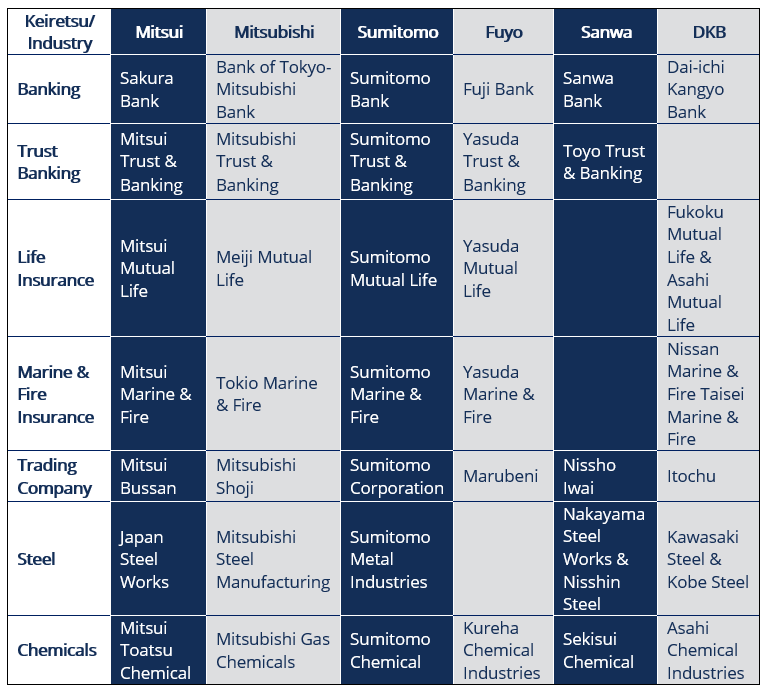
Source: Corporate Finance Institute (CFI)
The cross-ownerships among affiliated Japanese corporations, known or “keiretsu,” was hailed as an ingenious development in how these then-modern companies were structured, giving each a share of the benefits associated with their affiliates’ growing business and the rising stock prices of each.
Further, each affiliate owned a a piece of each of the others, a circular set of investments in which benefits accrued to all the other firms, especially the bank at the top of the structure … as long as growth continued unabated.
Mitsubishi Bank was a textbook case of how keiretsu worked … the bank owned shares in a variety of disparate operating firms from Mitsubishi Trust to Mitsubishi Trading and Mitsubishi Steel … and on and on, etc.
As the bull market roared throughout the 1980s, this cross-ownership structure provided extraordinary upside leverage to the keiretsu, as the Nikkei spiraled higher, taking each unit, and other major averages, like the Topix, ever higher in price, until the market cracked in 1989.
The leverage worked in reverse and the Nikkei, and its component companies, plunged from that high of nearly 39,000 to a low of nearly 5,000 both in 2005 and a subsequent re-test of those lows in 2010.
The banks at the center of the keiretsu suffered even more than their affiliates as their holdings, which counted as Tier 1 bank capital, in now failing enterprises impaired that capital rendering them technically insolvent.
Those lost decades were fraught with financial difficulties from which Japan’s economy never fully recovered.
Eventually, the market and economy partly worked through the massive downturn but not without losing global market share, suffering through multiple recessions and recurring bouts of deflation before stabilizing only recently.
Indeed, some 36 years later, in fact just this year, did the Nikkei hit a new all-time high having recovered from the so-called “lost decades” of Japan’s once superior economic growth and stock market strength.
The reason I am looking closely at this as a more apt analogy for the upward spiral in AI stocks is that they, too, are increasingly not just doing business with one another but also investing, in one another, both in their partners and competitors, while also using debt as the means to finance their purchases of chips, data center capacity, cloud space and software tools, in order to keep the rapid pace of growth from slowing down.
The key problems in doing this, of course, are two-fold.
First, the promise of AI may never deliver the hoped for revenues and profits currently embedded in the lofty stock prices and market valuations accorded to AI firms.
More important, if that’s true, the leverage propping up prices today, as was the case in Japan in the 1980s, could work in reverse and send all these high-flying stocks spiraling downward in a crash that mirrors the massive unwinding of cross-ownership among Japanese company stocks when their bubble burst in spectacular fashion.
It may not happen tomorrow, as the build-out is on-going in full-force.
There still may well be quite a bit of upside left in AI-related themes for a time to come … a melt-up before a meltdown, perhaps, as we have seen in prior market manias.
But, the more closely tied together these companies become, whether through vendor financed purchases, investments, or cross-ownership structures which, by the way, also include the U.S. government, the more violent the downside will be and the longer the ensuing bear market will last.
Although it’s a much overused expression, history may not repeat, but it rhymes.
The rhyme though today, as it were, may be much more Haiku than Iambic Pentameter, in this particular speculative episode.
We can only hope that the third line doesn’t lead to “seppuku” among those who thought the outcome, this time around, just might be different.
Wow, this is a genuinely great post - many thanks. Interesting, original and very useful to we mere mortals who are investing in financial markets, but frankly find AI hard to figure out in the sense of “where is this all heading?”
A few thoughts, all IMHO.
1. The Japan analogy, with the cross share holdings only making the boom & bust worse (and far more opaque) is interesting. I am old enough to remember the fascination with the rise of Japanese finance, sending brokers in London to start learning Japanese phrases to help phone calls to Tokyo.
Another amplifier of the boom was J companies issuing bonds with share warrants attached - warrants regarded as so valuable, due to ever rising share prices, that the bonds were sold at very low rates of interest. Thus debt finance became very cheap for J firms.
2. I had just moved to Australia when the crash started in 1989. So strong was the Yen at the time, giving J tourists incredible spending power overseas, that the Aus tourism industry followed events in Tokyo with keen interest.
3. Back to AI. I have increasingly started to think that the real benefit of AI will accrue to those companies who can best exploit it - I wonder how much profit the builders of AI data centres will extract from their investment in the long run. The Economist in last week’s issue highlighted how short lived these data centres might be, if chip designers are coming up with dramatically better chips every year or so.
4. Supporting this idea is my experience of using AI. Very obscure, specific Google queries can produce a helpful response in 10 seconds with AI digging up a document that I would have spent an hour searching for. How much has this cost me? Next to nothing it seems.
5. 6 months ago my other half wanted to make some changes to the investments of a small workplace pension scheme she was auto enrolled in a decade ago - something she had never done before. The AI chat bot was incredibly helpful, it was all sorted out in a couple of online sessions. That would have taken some time on a helpline 5 years ago. I was so impressed I immediately bought shares in the insurer that was providing the pension scheme.
That last encounter 6 months ago convinced me that AI could be very helpful to the financial services industry to cut costs/boost profits/ improve service - but that they would make more profit from AI than the provider.
6. Michael Green here on SubStack a few weeks ago speculated that the AI boom was reminiscent of the race to build high speed broadband networks during the dotcom bubble - expecting prices for customers to remain high. Instead the over supply of fibre networks led to a collapse in the price of Internet data, bankrupting many of the builders of this new internet data capacity - but led to newcomers like YouTube able to build new business models on the glut of cable. That might suggest that the builders of data centres, especially if taking on large debts, are taking a huge risk - unless they are using the data centres themselves to improve their business. The railway mania of the 19C comes to mind too - fantastically profitable, but not for the railway owners in many cases.
Excellent piece. Thanks for your insight. Time will tell.